

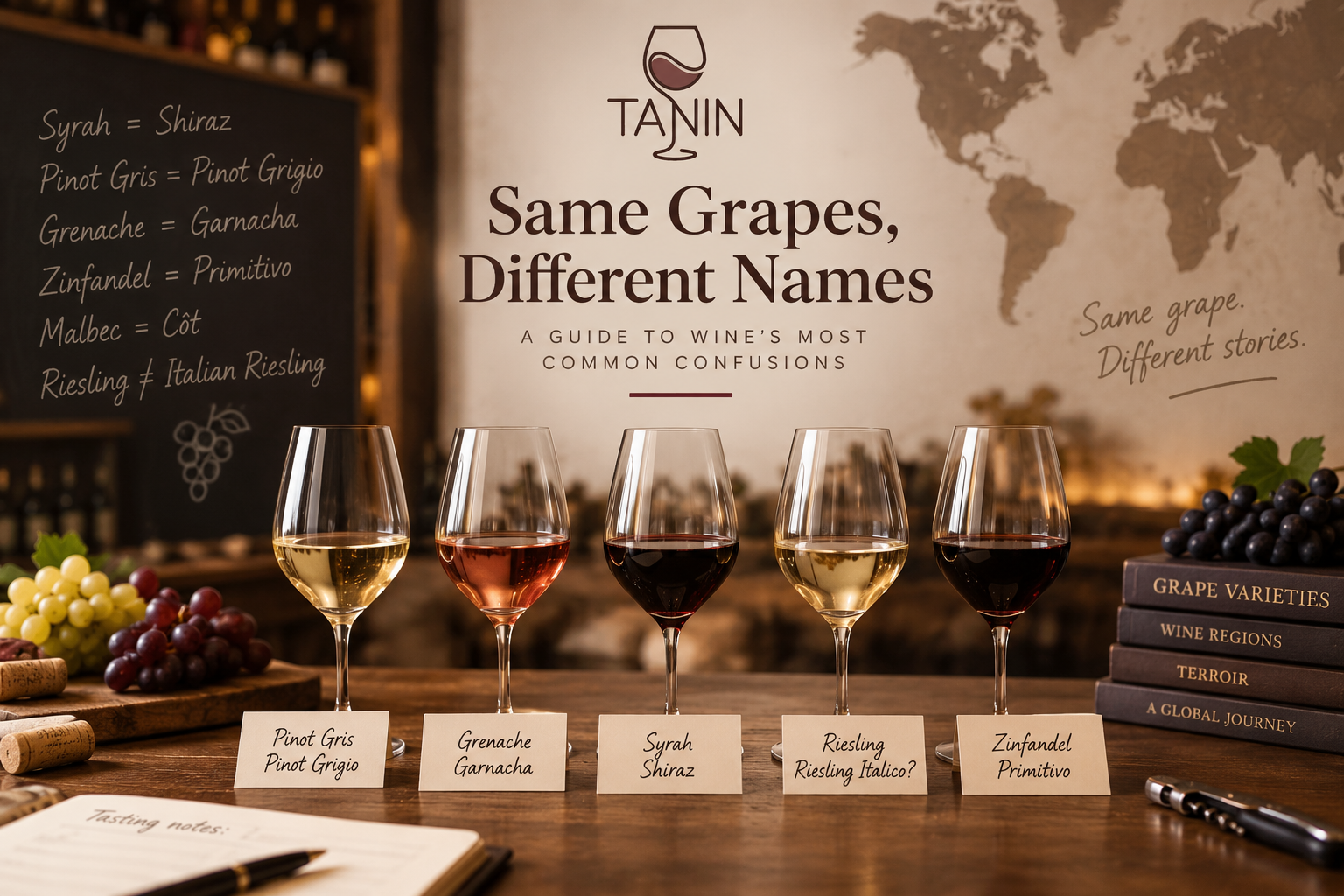
Syrah vs Shiraz: Differences and Common Grape Variety Confusions
If you have started exploring the world of wine, you have probably come across situations where two wines have completely different names, even though they are made from the same grape variety.
Syrah or Shiraz? Riesling or Italian Riesling? Pinot Gris or Pinot Grigio?
These are very common questions, even among wine enthusiasts with considerable experience.
The reason is simple: the same grape variety can have different names depending on the country, region, language, tradition, or even the style of wine being produced.
In this guide, we explore some of the most common grape variety naming confusions and explain how to understand wine labels more easily.
Syrah vs Shiraz: Are They the Same Grape?
Yes.
Syrah and Shiraz are two names for the same grape variety.
Syrah is the traditional name used in France, particularly in the Northern Rhône, while Shiraz became the iconic name for the variety in Australia.
So:
Syrah = Shiraz
However, this does not mean that every Syrah will taste exactly like every Shiraz.
Why can Syrah and Shiraz taste so different?
Because the name can also suggest a particular regional identity and wine style.
A Syrah from the Northern Rhône can be elegant, structured and relatively restrained, often showing aromas of violet, black pepper, black fruit and savory spices.
A Shiraz from a warm Australian region can be richer, fuller-bodied and more fruit-driven, with aromas of blackberry, plum and dark chocolate, sometimes accompanied by flavors derived from oak ageing.
Australian Shiraz can range from fresh, approachable and fruit-forward wines to powerful, concentrated wines designed for long-term ageing.
So if the label says “Shiraz”, is it a different grape?
No.
It is the same grape variety.
The difference is primarily related to regional tradition and wine style.
This leads to one of the most important principles in understanding wine:
The grape variety alone does not determine what a wine will taste like.
Climate, soil, vineyard location, harvest time, winemaking techniques and ageing can dramatically influence the final wine.
Riesling vs Italian Riesling: A Very Important Confusion
This is one of the most interesting naming confusions in the wine world.
If you see Riesling on a wine label, you should not automatically assume that it is the same grape as Italian Riesling.
They are, in fact, different grape varieties.
Riesling
When a wine simply says Riesling, it generally refers to the classic Riesling variety associated particularly with Germany and the Rhine region.
Riesling is one of the world’s most important white grape varieties and can produce an enormous range of styles — from bone-dry, high-acid wines to intensely sweet wines capable of ageing for decades.
Typical aromas can include:
- lime and lemon;
- green apple;
- peach;
- white flowers;
- mineral notes;
- petrol or kerosene-like aromas in mature wines.
Italian Riesling
This is where things become confusing.
Italian Riesling is not the same grape as Riesling.
The traditional Italian name Riesling Italico refers to the variety commonly known internationally as Welschriesling.
Therefore:
Riesling ≠ Italian Riesling
Although the names are remarkably similar, these are two different grape varieties.
Italian Riesling can produce fresh, light and citrus-driven wines and is found in several parts of Central and Eastern Europe.
This is a perfect example of why the name on a wine label should always be considered in its regional context.
How can you tell them apart?
Do not look only for the word “Riesling”.
Look for terms such as:
Riesling / Rhine Riesling / Deutscher Riesling → the classic Riesling variety.
Riesling Italico / Italian Riesling / Welschriesling → a different grape variety.
Pinot Gris vs Pinot Grigio
This one is much simpler.
Pinot Gris and Pinot Grigio are the same grape variety.
The difference is primarily linguistic and regional:
Pinot Gris → French name
Pinot Grigio → Italian name
The variety has naturally greyish-pink skins and can produce wines with very different styles.
Pinot Grigio
In northern Italy, Pinot Grigio is often associated with wines that are:
- fresh;
- crisp;
- citrus-driven;
- lightly floral;
- high in acidity;
- designed for relatively early drinking.
Pinot Gris
In Alsace, for example, Pinot Gris can have a much richer personality, often showing:
- greater body;
- richer texture;
- ripe fruit;
- spice;
- sometimes a touch of sweetness.
So:
Pinot Gris = Pinot Grigio
But, once again, the same grape does not automatically mean the same wine style.
Grenache vs Garnacha
Another classic example is:
Grenache and Garnacha are the same grape variety.
” Grenache ” is the French name, while Garnacha is the Spanish name.
The variety is extremely important in southern France and Spain and can be used to produce red, rosé and even sweet wines.
Depending on the region and winemaking style, Grenache can show aromas and flavors of:
- strawberry;
- raspberry;
- cherry;
- plum;
- spices;
- Mediterranean herbs;
- ripe fruit and warm alcohol.
It is also an important component of many traditional blends.
Mourvèdre vs Monastrell vs Mataro
Here we have another grape with several names.
Mourvèdre = Monastrell = Mataro
In France, the variety is primarily known as Mourvèdre.
In Spain, it is commonly called Monastrell.
In Australia and some other regions, it can be found under the name Mataro.
The variety is known for producing red wines with:
- structure;
- tannins;
- dark fruit;
- spice;
- savory and earthy characteristics.
Mourvèdre is particularly important in southern France, including the Rhône and Provence, where it is often blended with Grenache and Syrah.
Malbec vs Côt
If you have ever encountered a French wine labelled Côt and an Argentine wine labelled Malbec, you may have assumed that they were different grapes.
They are not.
Malbec and Côt are names for the same grape variety.
In Argentina, Malbec has become one of the country’s most important varieties, producing deeply colored, concentrated and fruit-driven wines.
In France, the variety is particularly associated with Cahors, where it can show a different expression due to climate, soil and winemaking traditions.
Once again, the same grape can produce remarkably different wines depending on where it is grown.
Tempranillo vs Tinto Fino vs Tinta del País
Another fascinating example is Tempranillo.
In Spain, the variety can appear under several regional names, including:
- Tempranillo;
- Tinto Fino;
- Tinta del País;
- Ull de Llebre.
These names are strongly associated with particular Spanish regions and traditions.
For wine consumers, the important point is that a wine from Ribera del Duero labelled Tinto Fino, for example, may be made from what consumers elsewhere know as Tempranillo.
The regional name can therefore tell you something not only about the grape, but also about where and how the wine was made.
Vermentino vs Rolle
In Italy, this white grape is primarily known as Vermentino.
In France, particularly in Provence and Corsica, it can appear under the name Rolle.
It is the same grape variety.
Vermentino typically produces fresh and aromatic white wines with good acidity and flavors that can include:
- citrus;
- white flowers;
- peach;
- herbs;
- tropical fruit;
- saline or mineral notes.
It is another excellent example of a grape variety changing its name when it crosses a national border.
Macabeo vs Viura
Another common Spanish example is:
Macabeo = Viura
Macabeo is used in several Spanish wine regions, while Viura is particularly important in Rioja.
It is a white grape that can produce both fresh, citrus-driven wines and richer, more complex examples, including wines aged in oak.
Again, the name on the label can reflect regional tradition rather than a completely different grape.
Zinfandel vs Primitivo
One of the most fascinating examples for wine lovers is:
Zinfandel = Primitivo
Zinfandel is strongly associated with California, while Primitivo is one of the signature varieties of Puglia in southern Italy.
The two names refer to the same grape variety.
However, a Californian Zinfandel and a Puglian Primitivo can taste quite different.
The climate, vineyard location, harvest decisions and winemaking techniques can all influence the final wine.
This is another reminder that wine is about much more than the grape variety.
Why Does the Same Grape Have Different Names?
There are several reasons.
1. History
Grape varieties have travelled between countries and continents for centuries.
Before modern genetic identification existed, individual regions developed their own names for grape varieties.
Over time, some of those names became deeply established.
2. Language
The same grape can receive a different name simply because of the local language.
For example:
Grenache → Garnacha
or:
Pinot Gris → Pinot Grigio
3. Regional Tradition
Sometimes a local name becomes so strongly associated with a region that it becomes the preferred name for the variety.
Shiraz in Australia is a perfect example.
4. Wine Style and Marketing
In some cases, producers deliberately choose one name rather than another to communicate a particular regional identity or stylistic expectation.
For example, some Australian producers use “Syrah” rather than “Shiraz” when they want to emphasize a more restrained or European-inspired style.
The Same Grape Does Not Mean the Same Wine
This is probably the most important lesson.
Imagine that you have two bottles:
Syrah – France
and
Shiraz – Australia
They are made from the same grape.
Yet they can taste remarkably different because of:
- climate;
- soil;
- altitude;
- vine age;
- harvest timing;
- grape ripeness;
- fermentation;
- oak ageing;
- bottle ageing;
- winemaking philosophy.
This is why experienced wine drinkers pay attention not only to the grape variety but also to where the wine comes from and how it was made.
When tasting wine, it is useful to think about three elements:
Grape variety → Place → Winemaking
Together, they help explain why two wines made from the same grape can be completely different experiences.
Quick Guide: The Most Common Grape Name Confusions
| Name 1 | Name 2 | Same variety? |
|---|---|---|
| Syrah | Shiraz | Yes |
| Pinot Gris | Pinot Grigio | Yes |
| Grenache | Garnacha | Yes |
| Mourvèdre | Monastrell | Yes |
| Mourvèdre | Mataro | Yes |
| Malbec | Côt | Yes |
| Vermentino | Rolle | Yes |
| Macabeo | Viura | Yes |
| Zinfandel | Primitivo | Yes |
| Riesling | Italian Riesling / Welschriesling | No |
| Chardonnay | Pinot Blanc | No |
| Sauvignon Blanc | Sauvignon Gris | No |
How to Read a Wine Label More Confidently
The next time you are standing in front of a wine shelf or looking at a wine list, don’t stop at the grape variety.
Ask yourself:
1. What grape variety is this?
2. Does this grape have another name?
3. Where does the wine come from?
4. What is the climate of the region?
5. Is the wine young or aged?
6. Was oak used?
7. Is the wine dry, off-dry or sweet?
These questions can tell you far more about the wine than the grape variety alone.
Want to Understand These Differences Through Tasting?
Reading about wine is useful, but the differences between grape varieties, regions and styles become much easier to understand when you taste them side by side.
At Tanin Cluj, we organize wine tastings where we explore different grape varieties, regions and wine styles, including comparative and blind tastings.
Blind tasting is particularly interesting because it removes the expectations created by the label. Instead of knowing that the glass contains an Australian Shiraz or a French Syrah, you can focus entirely on the wine itself — its aromas, acidity, tannins, body, alcohol and structure.
And when you taste two wines made from the same grape but from different regions, you can begin to understand what terroir really means.
In the end, wine is not just about the grape. It is about place, climate, people and style.
If you want to explore the world of wine in a relaxed and welcoming environment, join us at Tanin Cluj, in the heart of Cluj-Napoca, for a wine tasting experience focused on grape varieties, regions and the fascinating differences between wines.