
What Is Champagne?
Few wines have achieved the iconic status of Champagne.
Today, Champagne is synonymous with celebration, luxury, and elegance. However, very few people realize that only sparkling wines produced in a small region in northeastern France are legally allowed to use the name Champagne.
Every other sparkling wine, regardless of its quality, must use another designation, such as:
- Prosecco
- Cava
- Franciacorta
- Crémant
- Cap Classique
- Sekt
Understanding this distinction is one of the first steps toward appreciating the world of sparkling wine.
Where Does Champagne Come From?
The Champagne wine region is located approximately 150 km (95 miles) east of Paris.
Its cool continental climate, chalk-rich soils, and more than three centuries of winemaking tradition have made Champagne one of the world’s most prestigious wine regions.
The region covers approximately 34,000 hectares (84,000 acres) of vineyards and is home to:
- more than 16,000 winegrowers;
- around 360 Champagne houses;
- hundreds of millions of bottles produced every year.
Its unique terroir cannot be replicated anywhere else.
Who Invented Champagne?
One of the biggest myths in the wine world is that Dom Pérignon invented Champagne.
The truth is a little more complex.
Dom Pierre Pérignon was a Benedictine monk at the Abbey of Hautvillers during the 17th century.
His contributions to Champagne were extraordinary.
He improved:
- vineyard management;
- grape selection;
- blending techniques;
- the use of cork closures;
- overall wine quality.
However, he did not invent sparkling wine.
The bubbles appeared naturally because of Champagne’s cold winters.
Fermentation would stop during winter due to low temperatures and restart in spring once temperatures increased.
This second fermentation produced carbon dioxide inside the bottle, creating the bubbles we now associate with Champagne.
How Is Champagne Made?
One of the most searched questions online is:
How is Champagne produced?
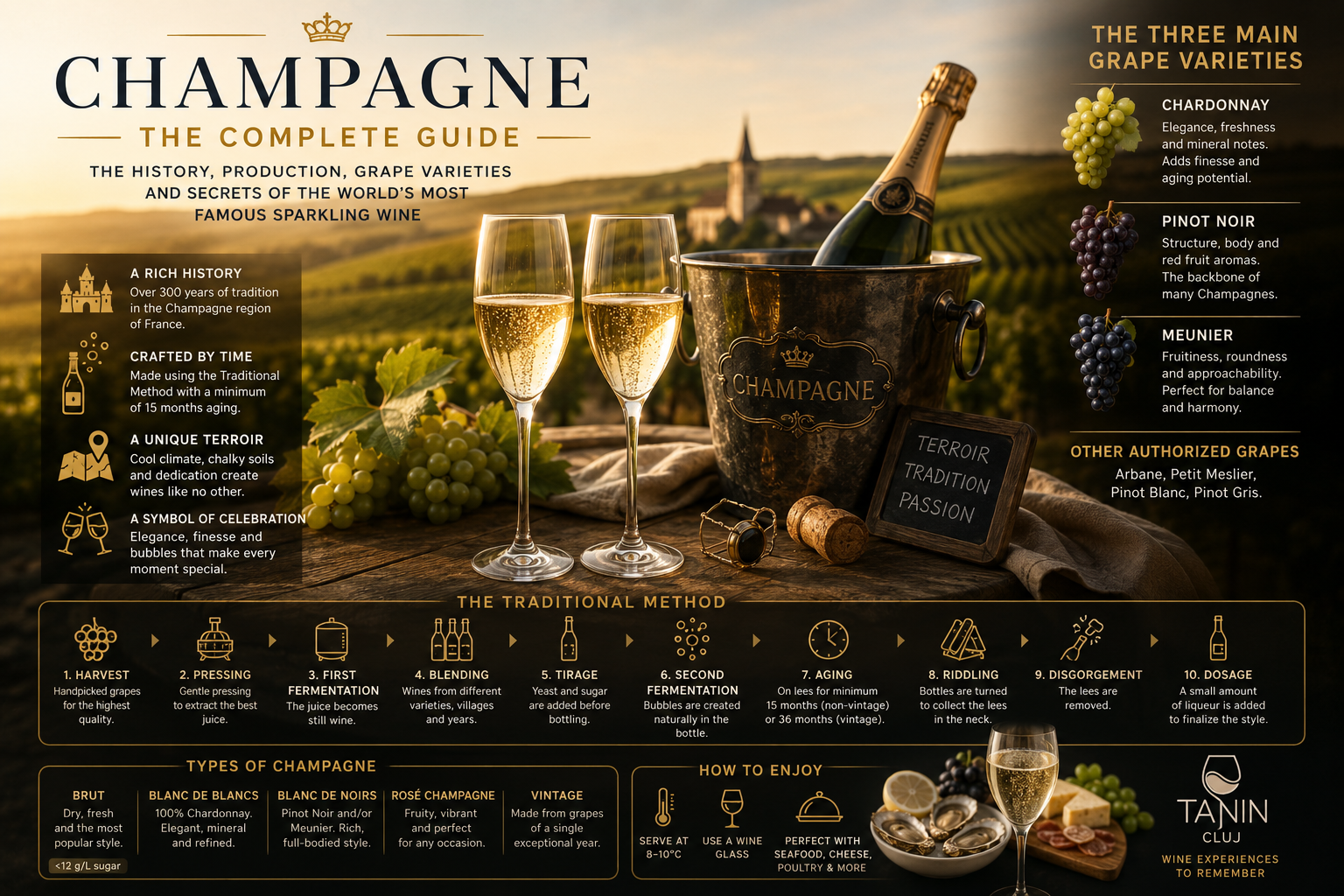
The answer lies in the Traditional Method (Méthode Traditionnelle), one of the most complex and time-consuming winemaking techniques in the world.
By law:
- Non-Vintage Champagne must age for a minimum of 15 months.
- Vintage Champagne must age for a minimum of 36 months.
Many prestige cuvées spend five to ten years aging before release.
Step 1 – Hand Harvesting
Every grape destined for Champagne must be harvested by hand.
Mechanical harvesting is prohibited to preserve grape quality and prevent premature oxidation.
Step 2 – Gentle Pressing
The grapes are carefully pressed to extract only the highest-quality juice.
Step 3 – First Fermentation
The juice is fermented into a still wine.
At this stage, there are no bubbles.
Step 4 – Blending (Assemblage)
This is where the artistry begins.
Winemakers blend wines from:
- different vineyards;
- different grape varieties;
- different villages;
- sometimes different vintages.
This blending process defines the signature style of each Champagne house.
Step 5 – Tirage
A mixture of yeast and sugar (liqueur de tirage) is added before bottling.
Step 6 – Secondary Fermentation
Inside the sealed bottle, fermentation starts again.
The carbon dioxide cannot escape, creating Champagne’s famous bubbles.
Step 7 – Aging on Lees
This stage creates many of Champagne’s most recognizable aromas.
The wine rests on dead yeast cells (lees), developing notes of:
- brioche;
- toasted bread;
- butter;
- hazelnuts;
- biscuits;
- pastry cream.
Longer aging generally results in greater complexity.
Step 8 – Riddling (Remuage)
The bottles are slowly rotated until all yeast sediment collects in the neck.
Step 9 – Disgorgement
The sediment is frozen and removed from the bottle.
Step 10 – Dosage
A small amount of wine and sugar (liqueur d’expédition) is added.
The amount of sugar determines the final sweetness level of the Champagne.
Which Grapes Are Allowed in Champagne?
Many people are surprised to learn that the Champagne regulations authorize seven grape varieties.
However, over 99% of all Champagne is produced from only three.
Chardonnay
Often described as the queen of elegance.
Typical aromas include:
- citrus;
- green apple;
- white flowers;
- chalk;
- minerality.
Chardonnay contributes:
- freshness;
- acidity;
- finesse;
- exceptional aging potential.
Pinot Noir
Pinot Noir provides:
- body;
- structure;
- red fruit aromas;
- depth;
- longevity.
It forms the backbone of many prestigious Champagnes.
Meunier
Often underestimated, Meunier contributes:
- ripe fruit;
- roundness;
- accessibility;
- youthful charm.
It is especially valuable in Non-Vintage blends.
The Other Authorized Grapes
Although rarely planted today, Champagne also permits:
- Arbane
- Petit Meslier
- Pinot Blanc
- Pinot Gris (Fromenteau)
These varieties represent only a tiny fraction of total vineyard plantings.
What Does Brut Mean?
Many people believe Brut simply means “dry.”
In reality, Brut refers to the amount of residual sugar.
Brut Nature
0–3 g/L
Extra Brut
0–6 g/L
Brut
Less than 12 g/L
Extra Dry
12–17 g/L
Sec
17–32 g/L
Demi-Sec
32–50 g/L
Doux
More than 50 g/L
What Is Blanc de Blancs?
Blanc de Blancs means “white from whites.”
It is made exclusively from Chardonnay.
These Champagnes are known for elegance, minerality, freshness, and exceptional aging potential.
What Is Blanc de Noirs?
Blanc de Noirs means “white from blacks.”
It is produced exclusively from:
- Pinot Noir;
- Meunier;
- or a blend of both.
These wines tend to be richer, fuller-bodied, and more powerful.
What Is Rosé Champagne?
Rosé Champagne can be produced in two ways:
- by allowing limited skin contact (maceration);
- by blending a small amount of still red wine into white Champagne.
Champagne is one of the very few wine regions where blending red wine into white wine to produce rosé is legally permitted.
The Most Famous Champagne Houses
Some of the world’s most prestigious Champagne producers include:
- Krug
- Bollinger
- Dom Pérignon
- Louis Roederer
- Ruinart
- Veuve Clicquot
- Pol Roger
- Billecart-Salmon
- Philipponnat
- Jacquesson
- Salon
- Egly-Ouriet
Each house has its own distinctive style, philosophy, and blending approach.
What Food Pairs with Champagne?
Contrary to popular belief, Champagne is not only for celebrations or desserts.
It pairs beautifully with:
- oysters;
- sushi;
- lobster;
- seafood;
- roasted chicken;
- truffles;
- aged cheeses;
- French fries;
- popcorn.
Yes—even popcorn.
Its high acidity and fine bubbles make Champagne one of the most versatile wines for food pairing.
How Should Champagne Be Served?
The ideal serving temperature is:
8–10°C (46–50°F).
Forget the narrow flute.
Today, many sommeliers recommend serving premium Champagne in a white wine glass, which better showcases its aromas and complexity.
Frequently Asked Questions
What is the difference between Champagne and Prosecco?
What is the difference between Champagne and Cava?
What is the best Champagne?
Why is Champagne so expensive?
How long does Champagne last after opening?
Can Champagne age?
What does Vintage Champagne mean?
What is Grand Cru Champagne?
How do I choose a good bottle of Champagne?
Which Champagne should I buy under €100?
Final Thoughts
Few wines have become universal symbols of celebration quite like Champagne.
Yet behind every bottle lies centuries of history, strict production rules, remarkable craftsmanship, and extraordinary diversity.
At Tanin Cluj, we believe Champagne is far more than a festive drink—it’s one of the world’s greatest wine experiences.
Through our themed sparkling wine tastings, you’ll discover the fascinating differences between Champagne, Prosecco, Franciacorta, Cava, and Cap Classique, comparing each style side by side while learning what makes them unique.
Whether you’re just beginning your wine journey or you’re already passionate about fine sparkling wines, understanding Champagne will forever change the way you appreciate every glass.